Reading the map
The Principality runs along four kilometres of coast between France on three sides and the Mediterranean on the fourth. From west to east: Fontvieille on reclaimed land, Monaco-Ville on the Rock, La Condamine around Port Hercule, Jardin Exotique and Moneghetti on the hillside above, Monte-Carlo at the centre, Larvotto on the beach, La Rousse and Saint-Roman on the eastern heights, and Mareterra, the newest extension into the sea below Larvotto. According to IMSEE, Monte-Carlo and La Rousse together hold more than 40% of the residential floor area.
Monte-Carlo and the Carré d’Or
The historic centre of luxury around the Casino, the Hôtel de Paris and the Métropole. The Carré d’Or, the few streets between the Casino gardens and the sea, is the most sought-after address in Monaco, with landmark residences such as the Park Palace, the Mirabeau, One Monte-Carlo and the Monte Carlo Star. Expect the widest choice of large apartments, the most shops and restaurants at your door, and prices at the top of the market. The eastern side towards Larvotto is quieter and more residential than the Casino square itself.
Larvotto
Monaco’s beach district, remodelled in 2021 with a new promenade and refined further by the arrival of Mareterra next door. Larvotto’s seafront towers (Le Formentor, L’Estoril, Le Roccabella, Le Columbia Palace, La Réserve) offer the most direct sea views in the Principality. In 2025 the district became the first to exceed €70,000 per square metre in the IMSEE statistics, driven by new deliveries. Ideal for those who want the sea every morning and do not mind a short walk or drive to the centre.
Mareterra
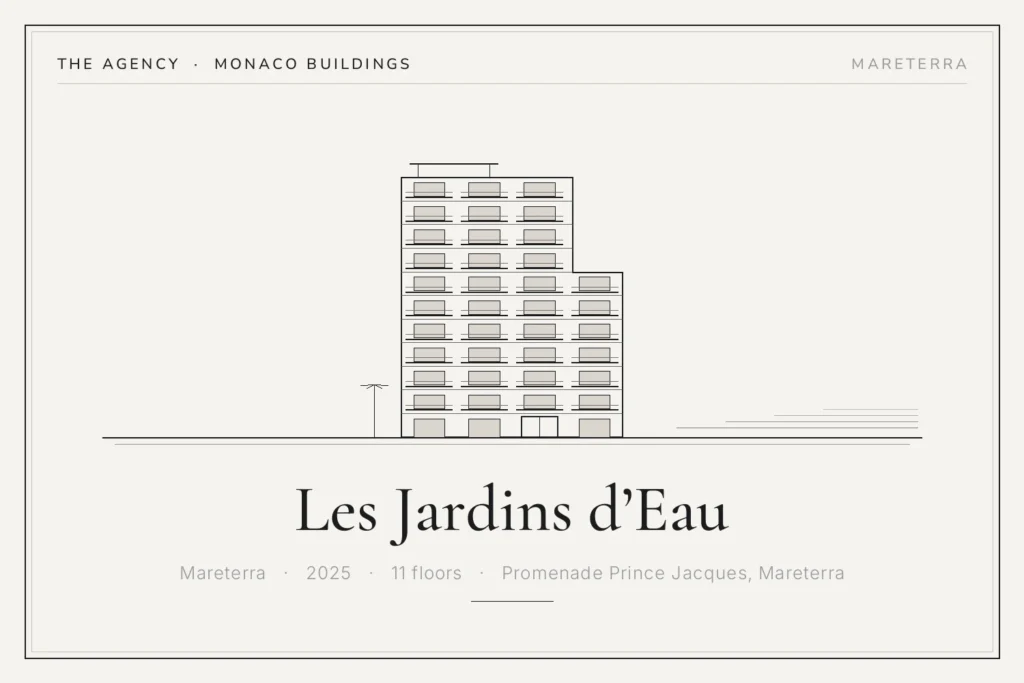
Six hectares reclaimed from the sea and inaugurated in December 2024, Mareterra is the Principality’s newest quarter: Renzo Piano’s Le Renzo, Les Jardins d’Eau, a handful of villas and townhouses, a marina, a public park and a seafront promenade. Supply is tiny and largely placed off-plan; resales are rare and command a premium. It suits buyers who want new construction, absolute discretion and contemporary architecture rather than the Belle Époque.
La Condamine and Port Hercule
The most lived-in part of Monaco: the daily market on Place d’Armes, the port with its yachts and the Grand Prix circuit, Rue Grimaldi and Rue Caroline for shopping. Buildings range from pre-war addresses to modern residences such as Le Panorama, Le Shangri-La and Les Caravelles on the port. Apartments facing the harbour are among the most atmospheric in the Principality; those in the back streets offer better value a few minutes from everything.
Fontvieille
Built on land reclaimed in the 1970s and 1980s, Fontvieille is Monaco’s family district: a marina, the stadium, the Princess Grace rose garden, schools and the shopping centre, all on flat ground. Residences such as Seaside Plaza, Le Memmo Center, L’Eden Star and the Renaissance-named buildings (Le Botticelli, Le Titien, Le Raphaël, Le Michelangelo) offer spacious apartments with large terraces at prices below Monte-Carlo and Larvotto. Quieter in the evening, excellent for children and for anyone who values space over nightlife.
Jardin Exotique and Moneghetti
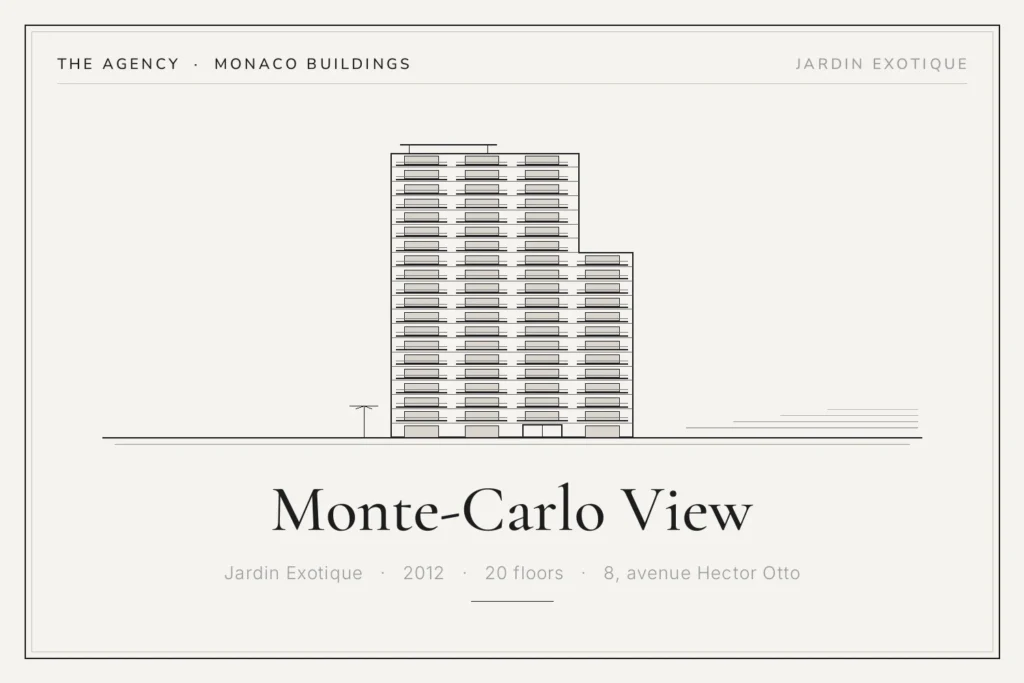
The hillside above the port, with the best panoramic views in Monaco and some of its best value. Jardin Exotique is residential and calm, with buildings such as Le Patio Palace, Le Simona and Monte-Carlo View; Moneghetti, closer to the centre, has seen recent deliveries including Le Stella and L’Exotique. The compromise is topography: you rely on lifts, buses and public escalators, and the sea is a view rather than a short walk.
La Rousse and Saint-Roman
The eastern heights on the French border, home to Monaco’s tallest towers (Odéon, Le Parc Saint-Roman, Monte-Carlo Sun, Château Périgord, Château Amiral) and, below them, Bay House, delivered in 2024–2025 as part of Testimonio II. Many apartments here enjoy sea views over Larvotto and the Italian coast, floor plans are generous and families appreciate the proximity of the international school. Prices range from the most accessible in Monaco in older towers to the highest in the new deliveries.
Monaco-Ville
The Rock: the Prince’s Palace, the Cathedral, the Oceanographic Museum and narrow streets of pastel houses. It is the most picturesque district and the one with the fewest opportunities for international buyers, since much of its housing is State-owned or in the protected sector reserved for Monegasque nationals. When a free-sector apartment appears, as in Le Rocamar or Le Giardinetto, it is a rarity.
Choosing
- For the sea: Larvotto, Mareterra, the seafront of La Rousse.
- For the centre and the address: Carré d’Or and Monte-Carlo.
- For families: Fontvieille, La Rousse near the schools, the quieter streets of Monte-Carlo.
- For value and views: Jardin Exotique and Moneghetti.
- For atmosphere: La Condamine and the port.
Whichever district you choose, the building decides your daily life. Our Buildings in Monaco index lets you browse the Principality’s residences by district, with facts, map and current listings for each.
Frequently asked questions
Which is the best district to live in Monaco?
It depends on how you live. Monte-Carlo and the Carré d'Or are the most central and prestigious, Larvotto and Mareterra are for the sea, Fontvieille and La Rousse suit families, and Jardin Exotique and Moneghetti offer the best value and views.
Which Monaco district is the most expensive?
In the IMSEE statistics for 2025, Larvotto became the first district to exceed €70,000 per square metre, driven by new deliveries. The Carré d'Or in Monte-Carlo remains the most sought-after address for large, established apartments.
Where are the family-friendly areas of Monaco?
Fontvieille, flat and close to schools, the stadium and the shopping centre; La Rousse near the International School of Monaco; and the quieter residential streets of Monte-Carlo towards Larvotto.
Can foreigners buy in Monaco-Ville?
Rarely. Much of the housing on the Rock is State-owned or in the protected sector reserved for Monegasque nationals. Free-sector apartments do exist but come to market infrequently.
What is Mareterra?
Monaco's newest district, six hectares reclaimed from the sea below Larvotto and inaugurated in December 2024. It comprises Le Renzo by Renzo Piano, Les Jardins d'Eau, a few villas and townhouses, a marina and a public park.
General information, not legal, tax or immigration advice. Figures reflect market practice at the review date.
Sources
- IMSEE – Real Estate Observatory 2025 (district data) (consulted 15 November 2026)
- Mareterra – official site (consulted 15 November 2026)
- Monaco Government – Districts (consulted 15 November 2026)